> For the complete documentation index, see [llms.txt](https://myxfinance.gitbook.io/myx/llms.txt). Markdown versions of documentation pages are available by appending `.md` to page URLs; this page is available as [Markdown](https://myxfinance.gitbook.io/myx/tutorials/how-to-trade-on-arbitrum-one-and-linea/trade-process.md).
# Trade Process
MYX is an innovative decentralized perpetual exchange that achieves zero slippage through its unique Matching Pool Mechanism (MPM). Seamlessly matching long and short positions, MYX enables capital efficiency up to 125x, unlocking boundless opportunities for traders.
### Connect Wallet
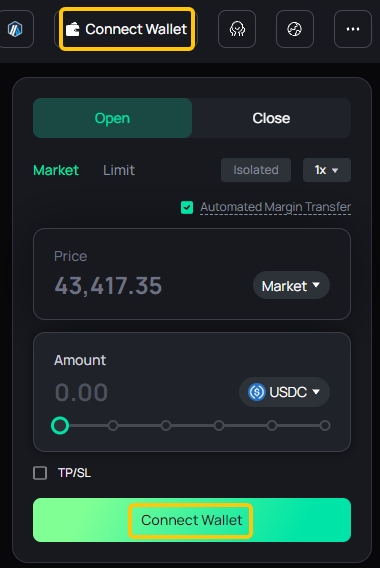
Step 1: Click the “Connect Wallet” button to open the Connect Wallet dialog.
Step 2: Select the type of wallet you want to use. If you haven't installed a browser wallet yet, it is recommended to install MetaMask. More wallets will be integrated in the future.
### Select Network
Currently supports Linea and Arbitrum. You can add and switch networks by clicking the “Network Error” button.
### Select Market
Click the Market button on the information bar to open the dialog box, and then select the market you wish to trade in.
### Open Position
Step 1: “Adjust leverage”, with a minimum support of 1x leverage and a maximum support of 50x leverage.
* Using leverage increases your exposure to market fluctuations and accordingly, the risk of liquidation. Please be mindful of risk management.
Step 2: Cancel “Automated”-Add margin, which refers to the funds that users need to deposit in advance when engaging in derivatives trading, used to ensure the fulfillment of the trade.
Step 3: Select the order type you need to use. Two types of orders are offered: market orders and limit orders.
* **Market Order**
Fill orders with the latest market price.
* **Limit Order**
Open Long: Fill orders when the mark price is lower than or equal to the limit price.
Open Short: Fill orders when the mark price is higher than or equal to the limit price.
Step 4: Change the display mode according to your preference, then slide and enter the quantity.
* USDT: You will see the value of the order represented in the stablecoin USDT.
* Coin Information: You will see the quantity of the order represented in specific cryptocurrencies
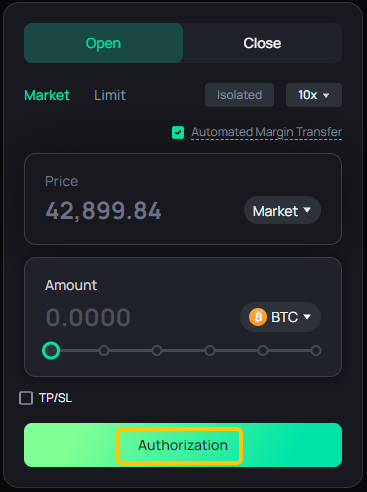
Step 5:Authorization
You will receive a signature request. Signing is free and will not result in any transaction broadcast. The signature is only to verify your wallet ownership and authorize transactions.
Step 6: Click "Open Long" or "Open Short" to open the confirmation dialog box.
* Open Long: When you "open long," you predict that the asset price will rise. Simply put, you buy an asset hoping to sell it at a higher price in the future, thereby making a profit.
* Open Short: When you "open short," you predict that the asset price will fall. This means you sell an asset first (even if you don't own it at the time) and then buy it back at a lower price in the future, thereby making a profit.
Step 7: Display the relevant information for opening the position, click the "CONFIRM" button, and proceed to wallet authorization to complete the position opening.
### Automated Margin Transfer
Click"Automated", MYX will automatically read the wallet balance, select the leverage ratio, and choose between limit/market order, then directly enter or slide the quantity and click。
Click"Open Long" or "Open Short"
* Available Long/Short: **The current maximum position size.** The example above indicates that the trader can currently go long up to 909,694.62 U. The available liquidity for long and short positions is calculated separately; it varies with changes in the total open positions.
* Open Interest (Long)/(Short): The current number of open long and short positions on the MYX.
* Long-Short Ratio: The current long-short ratio on the MYX.
### Position Information
View position-related information in the bottom left corner.
### TP/SL
Click on “TP/SL” below the position, enter the price, and ensure that your price aligns with the direction of your open position for a 100% quantity close.
### Advanced TP/SL Settings.
Click the “Advanced” button, select the direction of the position opening, then choose “Take Profit” or “Stop Loss”, enter the price and the percentage of the position quantity to be closed, and click 'Confirm'. You can also set this in the “Position” section.
### Close position
Select market or limit order, enter or slide to choose the quantity of the position you want to close. Avbi displays the maximum closable position quantity for different directions. Click "Close Long"/"Close Short" and then click "Confirm".
You can also close through the "Close" in the "Position" information, liquidating the entire position quantity at the current price.
### Adjust Margin
Increasing the margin raises the liquidation price to prevent liquidation, while reducing the margin increases the risk of liquidation.

.PNG?alt=media&token=3028c241-95b5-48ff-b7b5-ec28a7566294)

.PNG?alt=media&token=d69bb811-be1e-4118-a0de-bb57edfa6cc8)
.PNG?alt=media&token=3176854a-1458-42d3-b46a-3ea5cdaa252d)